

A CMDB supports impact analysis when it links technology to the services people depend on. Start with one important service, such as registration, map what it depends on, and test the model against a real incident before expanding it.
Imagine a problem with the identity service just as students are trying to register. You may be able to identify the affected servers, see the alerts and contact the infrastructure team. But can you quickly tell which student-facing services are at risk, who needs to know and where to send the work?
That is the question I’d use to test a service model.
University IT teams often hold plenty of technical information. What can be harder to find is a reliable connection between the technology and the services people depend on. A CMDB full of records isn’t much help to an IT Director if it can’t support a decision during an outage or a change.
Start with a real dependency
I’d choose one important service and work backwards from what students or staff need to do. Registration is a useful example because timing matters and several systems may need to work together.
Begin with the people responsible for the service. Ask what must be available for a student to complete registration, which applications support it and which teams can help when something fails. Then bring in the technical teams to validate the application, integration and infrastructure dependencies.
You’re not trying to capture the entire university estate in the first workshop. You’re trying to establish a model that someone can use to answer a practical question.
What does a CMDB need for impact analysis?
This is where Halo’s Service Data Model is useful. It provides a structure for relating Business Services to IT Services, applications, their instances and the underlying infrastructure configuration items.
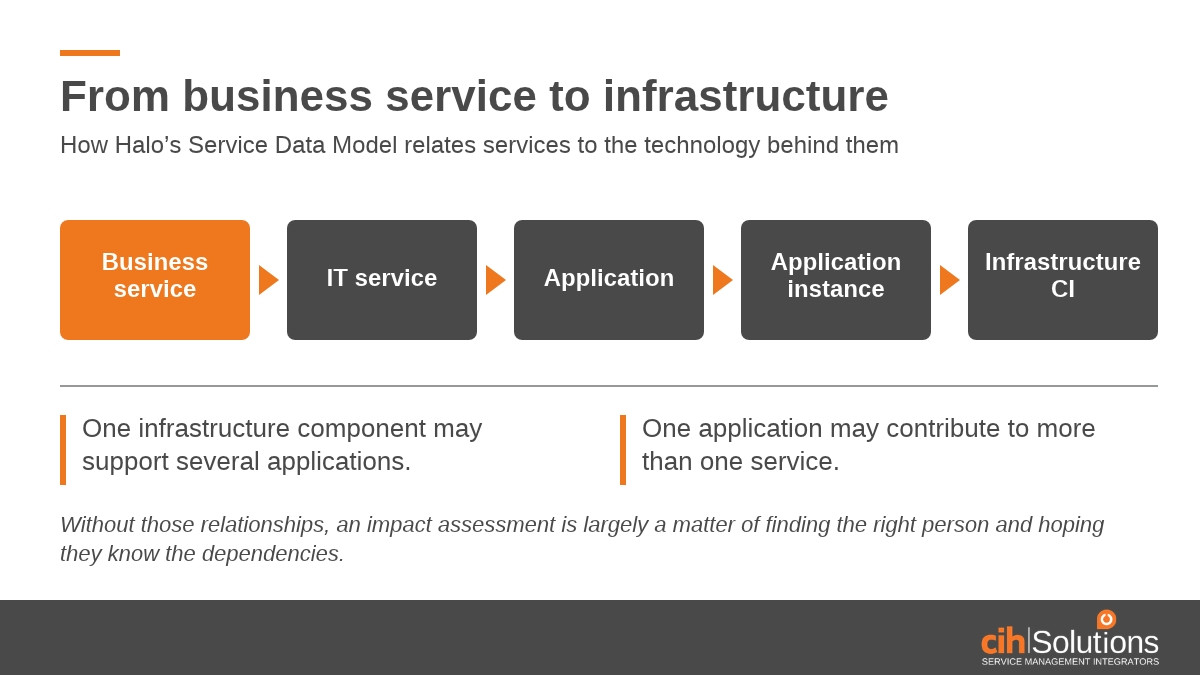
The distinction is critical because an infrastructure component may support several applications, and an application may contribute to more than one service. Without those relationships, an impact assessment is largely a matter of finding the right person and hoping they know the dependencies. That’s commonly where CMDB-led projects start to unravel.
| If you’re… | I’d start by… |
|---|---|
| Already using Halo | Taking one incident or proposed change and seeing whether the current records tell the right story. If they don’t, identify which relationship or ownership information is missing. |
| Considering Halo | Using the same exercise to agree the minimum service information needed before building out the model. |
How do you test whether a service model works?
There are three things I’d test before expanding it.
| Test | Why it matters |
|---|---|
| Can the service desk identify the affected service? | If the first-line team can see only a technical component, they’ll still need to work out what it means for students and staff. |
| Can someone identify the right people? | A useful model links the service to operational support and accountable decision-makers. Otherwise the record may be accurate while the incident still goes round in circles. |
| Will the information stay current? | Agree who updates relationships when applications change, suppliers move or infrastructure is replaced. A model that only reflects the day it was created soon loses its value. |
Where should you start with service modelling in Halo?
- Choose a small number of services with a clear operational reason for modelling them.
- Confirm the service definition with the people who rely on it.
- Map the supporting IT services and applications.
- Validate the dependencies with the technical teams.
- Record the support and accountability arrangements, then test the model against a real incident or change scenario.
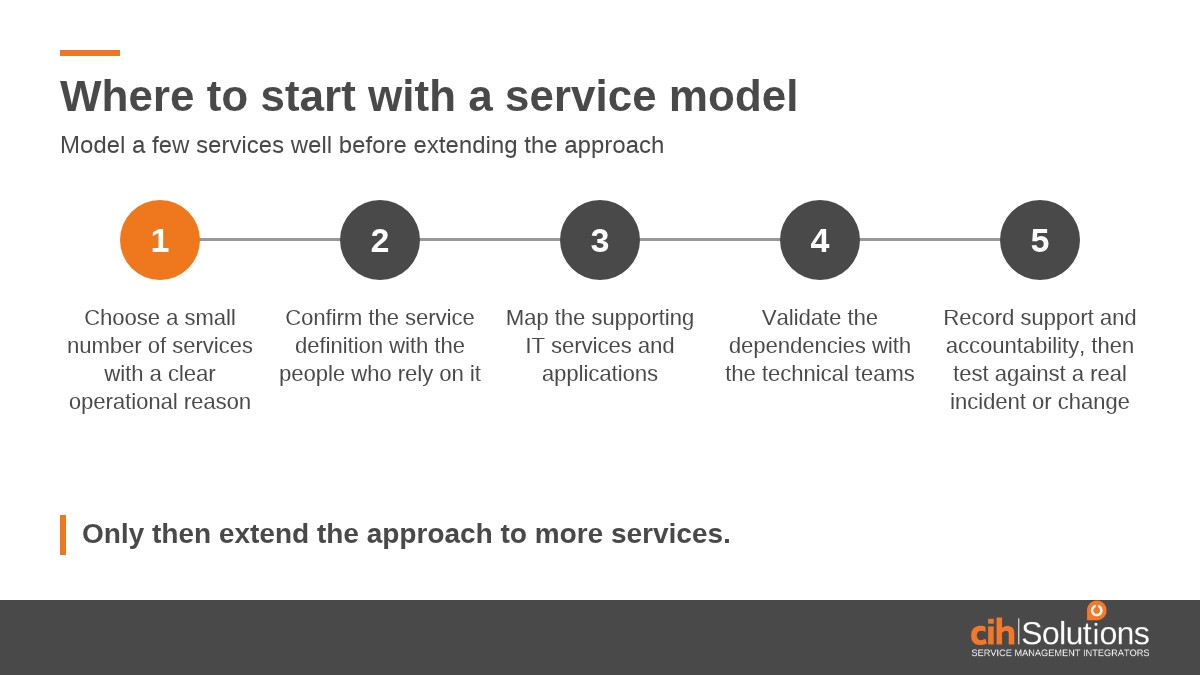
Only then would I extend the approach to more services. It is much easier to improve a small model that people use than to maintain hundreds of records whose purpose nobody can explain.
That’s also how I’d judge progress: can the team assess impact more confidently, route work more consistently and explain what matters when a service is at risk?
Compare approaches at Halo Connect
On Thursday 26 November 2026, CIHS and Halo are bringing university IT service leaders together in London for Halo Connect: Higher Education.
The Service Data Model and CMDB are on the agenda, alongside a practical look at AI and chat. It is a small, discussion-led event, with live demonstrations where useful. You’ll be able to compare approaches with peers and put questions directly to Halo’s team.
If you’re already using Halo, it should help you think about where to focus next. If you’re assessing the platform, you’ll hear how the underlying service model supports the wider service management picture.
Halo Connect: Higher Education | Thursday 26 November 2026 | London
A free event for university IT service leaders using Halo or considering it. Discuss the Service Data Model, CMDB and the decisions that help institutions get more value from the platform. Places are limited.


